

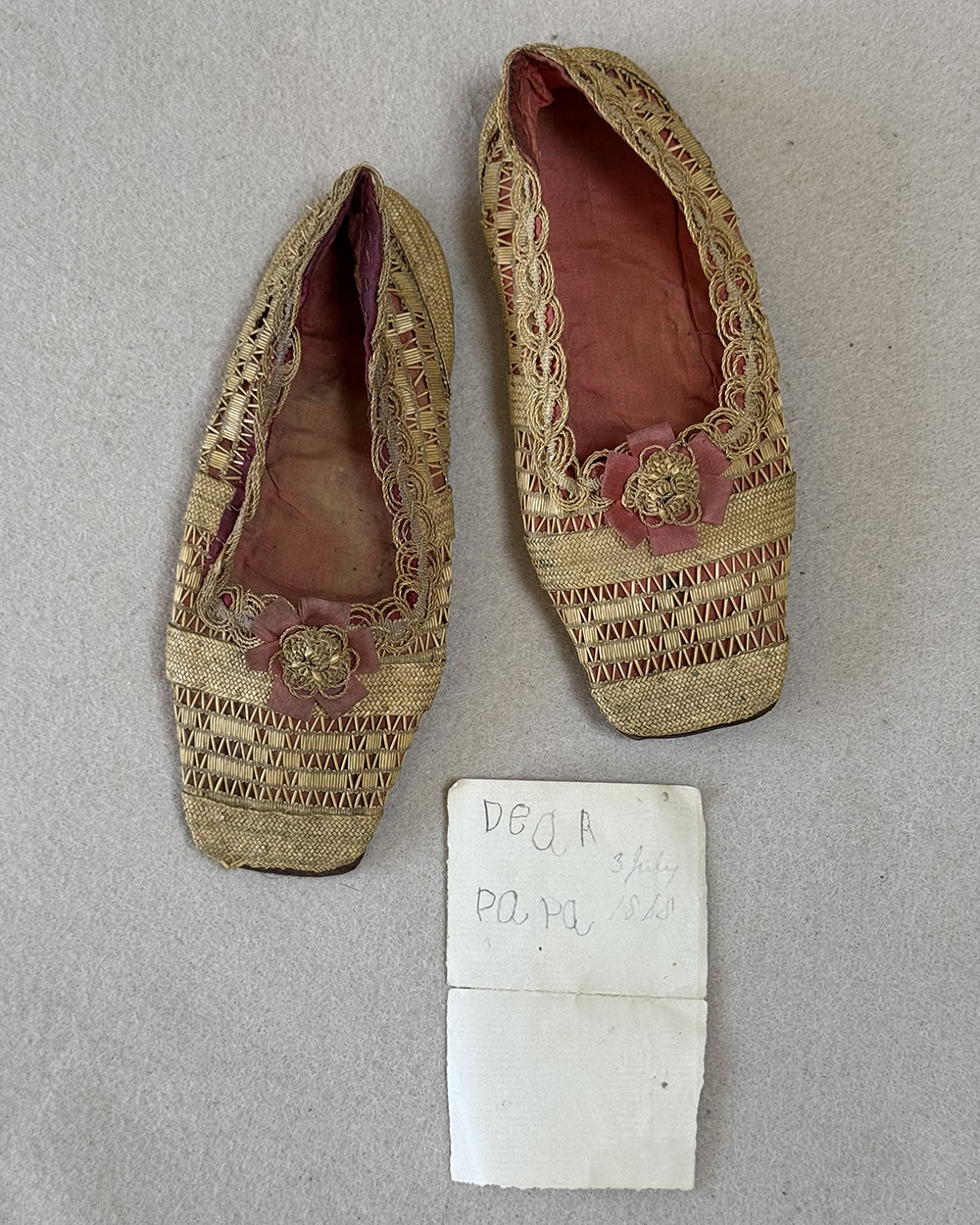



There was a note in one of the shoes: Probably Grace Faues about 1866. The other side is very childish handwritting Dear Papa. It is dated by an adult 3 July 1868. There is a similar pair in the Victoria & Albert Museum's collection.
Enormous thanks to Veronica Main for the following information: These are typical of plaits being made in Italy in the 19th century. The straw is a very fine grass which is another characteristic of Italian work. The plaits have been stitched together edge to edge – another Italian trademark.The pattern of plait, and method of stitching side by side were common products during the 19th century therefore would have been available in the 1860s and beyond. The openwork inserts are made on a loom and were typical products made in and around the village of Fiesole near Florence from the 1820s onwards. The rosette comprises a plait called Ring which was commonly made in Switzerland and Italy. The loops are two ply threads made using another product called Schnürli. These were made in Switzerland and Germany, but by some time in the 1850s were also being made in Italy. From the image the threads do not seem as fine as I would expect from Switzerland or Germany but are representative of the quality made in Italy. The edging is a very typical loom-woven braid. The weft loops are Schnürli, and the warp is probably silk. This will date to the mid 19th century. Do take a look at Veronica's website*
By the mid-19th century Florence was not only a tourist destination famed for its Public Straw Markets which not only sold hats, but other products. The shoes may be what we might now describe as tourist goods for wealthy women and children, but that should not demean their quality and relevance as a fashion image.
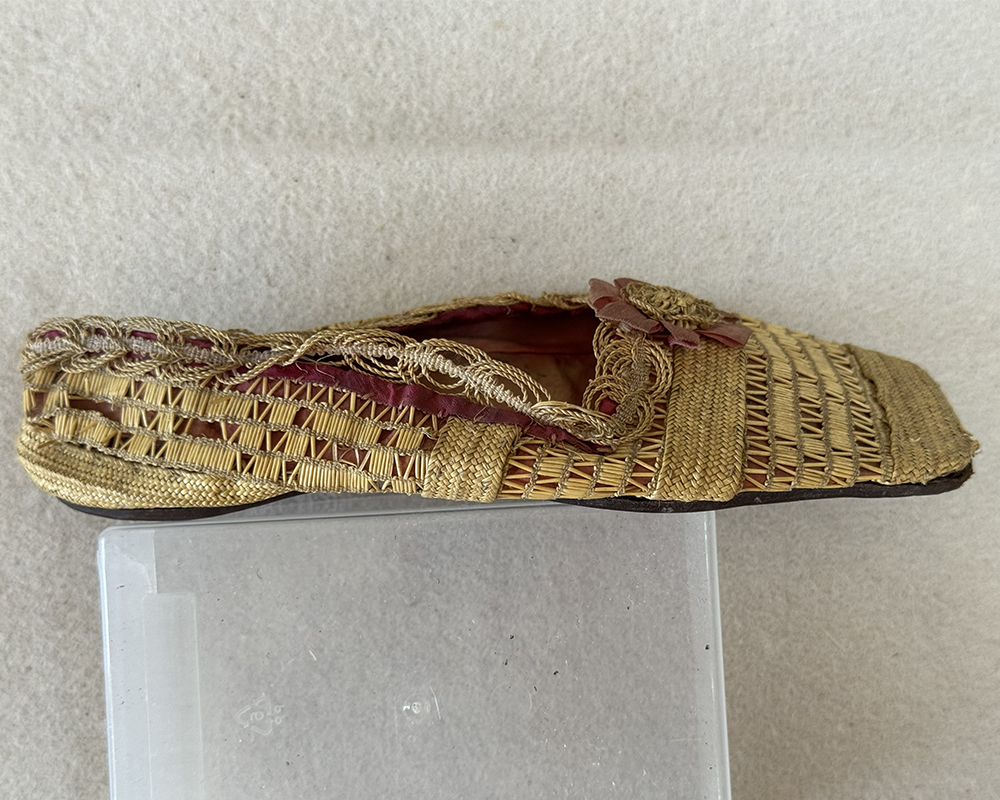
A pair of woven and plaited straw shoes for a young girl, each with three bands of plaited straw, alternating with open-work straw, a small straw work motifs and pink looped silk ribbons to the tongue, a circular repeating pattern to the top edge, lined in coral silk, the leather straight soles inked with 32.
Length 6 in; 15 cm
They need a little support to reshape them, but the backs are not broken, as one might suspect. The left hand shoe has a very little damage to the toe area and the silk rosette is slightly faded, as you should be able to see in the photos.
* hatplait.co.uk/
collections.vam.ac.uk/item/O1122736/shoe-unknown/ Given by Queen Mary.
The Seductive Shoe Jonathan Walford p92.
Shoes and Slippers from Snowshill. Althea Mackenzie p 62 shows an almost identical adult shoe.
fidmmuseum.pastperfectonline.com/webobject/E658A1B6-872A-4E92-A41C-956916168453
Price: on request
Ref N°: 1622


All images and text © meg-andrews.com 2026
